

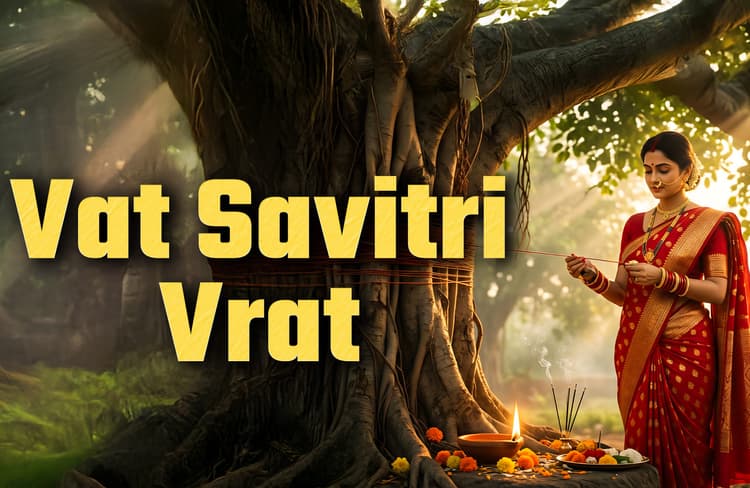
Vat Savitri Vrat – Married Women Fasting & Rituals
Vat Savitri Vrat 2026
In our Sanatan culture, every lunar day brings with it some form of religious observance or festival, and these celebrations are deeply rooted in our ancient traditions. Our festivals are connected not only with our personal lives but also with the natural world. The Vat Savitri Vrat is one such festival, during which the Banyan tree is worshipped, and a fast is observed to pray for the longevity of one's husband. The Vat Savitri Vrat is regarded as a symbol of the unbreakable bond of love between husband and wife, their mutual devotion, and enduring marital bliss. Married women observe this fast with profound faith and devotion, praying for their husbands' longevity, happiness, and prosperity, as well as for the overall well-being of their families. On this day, they worship the Banyan tree and listen to the story or katha of Savitri and Satyavan. According to the legend, this fast possesses such immense power that Savitri was able to reclaim her husband Satyavan's life from Yam the God of Death.
The Vat Savitri Vrat is observed annually on the day of Jyeshtha Amavasya; however, in certain regions, this fast is observed on Jyeshtha Purnima. According to the Panchang, most festivals in the Amanta and Purnimanta lunar calendars are celebrated on the same day; yet, in the North Indian states such as Uttar Pradesh, Madhya Pradesh, Bihar, Punjab, and Haryana, the Vat Savitri Vrat is observed according to the Purnimanta calendar, specifically on Jyeshtha Amavasya. Conversely, in other regions, the Vat Savitri Vrat is celebrated according to the Amanta lunar calendar, that is, on Jyeshtha Purnima. Consequently, it is observed that in Maharashtra, Gujarat, and the South Indian states, the Vat Savitri Vrat is observed fifteen days after Jyeshtha Amavasya.
Vat Savitri Vrat Date, Time, Muhurat & Tithi 2026, 2027, 2028
Vat Savitri Vrat is observed every year on the day of Jyeshtha Amavasya in the year 2026. Vat Savitri Vrat falls on May 16. The Jyeshtha Amavasya Tithi begins on May 16 at 5:11 AM, while it concludes in the early hours of May 17 at 1:30 AM.
| Year | Vat Savitri Amavasya | Vat Savitri Purnima Vrat | Amavasya Tithi Begins | Amavasya Tithi Ends |
|---|---|---|---|---|
| 2027 | Friday, June 4, 2027 | Friday, June 18, 2027 | June 04, 2027, at 04:05 AM | June 05, 2027, at 01:09 AM |
| 2028 | Wednesday, May 24, 2028 | Tuesday, June 6, 2028 | May 23, 2028, at 02:09 PM | May 24, 2028, at 01:45 PM |
What is Vat Savitri Vrat?
Married women observe the Vat Savitri Vrat to pray for the longevity of their husbands. In the context of Vat Savitri, 'Vat' refers to the Vat Vriksha (the Banyan tree), while Savitri is the legendary woman who successfully reclaimed her husband Satyavan's life from Yamraj. Consequently, it is believed that this fast grants immense power.
Vat Savitri Vrat Katha (Detailed Story)
Observe the detailed story (katha) of Savitri and Satyavan through the chapters below:
King Ashwapati and the Birth of Savitri
Once upon a time, in the land of Bhadra, there lived a king named Ashwapati. However, he was childless. Driven by a deep desire for a child, he began a daily routine of chanting mantras and offering one hundred thousand oblations into the sacred fire. He continued this practice for eighteen years. Witnessing the King's devotion, Goddess Savitri appeared before him and granted him a boon: "O King, you shall be blessed with an intelligent and beautiful daughter."
Some time after receiving the Goddess's blessing, a daughter was born in the King's household. Since the child's birth was a result of Goddess Savitri's grace, the King named her Savitri.
Savitri Chooses Satyavan
As Savitri grew into womanhood, she blossomed into a young woman of extraordinary beauty and grace. However, the King was troubled, for he could not find a suitable husband for her. Consequently, he sent Savitri forth to choose a husband for herself through a Swayamvar (a ceremony where a bride selects her own groom). Savitri began wandering through the Tapovan (forest) in search of a suitable partner. There, she met Dyumatsena, the former King of the Salva Kingdom, who had been deprived of his throne and kingdom. Upon meeting him and his son, Savitri decided to marry Satyavan, the King's son.
Narad Muni’s Prediction
When Narad came to know that Savitri had chosen Satyavan as her husband, he went to King Ashwapati and said, "O King, what are you doing? Satyavan is undoubtedly virtuous, strong, and righteous. However, he is destined to have a short life. His death is fated to occur exactly one year from now."
Savitri’s Difficult Married Life
Savitri's father tried to stop her from marrying Satyavan, yet despite his repeated pleas, Savitri remained on her word on accepting Satyavan as her husband. She tells her father that noble girls marry their husbands once, and in the same way, the king gives the command once, the priest promises once, and the kanya daan is also done once.
On Savitri's determination, the King finally surrendered him, and Savitri was married to Satyavan. After her marriage, she moved to her marital home, where she began to serve not only her husband but also her parents-in-law. Even with the knowledge of Satyavan's impending death, she served her family with full devotion.
The Day of Satyavan’s Death
As Satyavan's death day came near, Savitri grew increasingly anxious. With only three days remaining, she commenced a fast and, following the words of Narad, performed rituals of Tarpan and worship of forefathers (Pitra).
Every day, Satyavan used to go into the forest to gather firewood for their needs. On the day of his death, Savitri accompanied him. While Satyavan was cutting wood from a tree, he suddenly felt a searing pain. The agony became unbearable, and he fell from the tree. Witnessing this, Savitri realised that the moment of Satyavan's death had arrived. Just then, Lord Yam, the God of Death, appeared and began to lead Satyavan's soul away.
Savitri Follows Yamraj
Savitri began to follow Lord Yam from behind. Yam stopped her from accompanying him, explaining that this was already decided and could not be changed. However, Savitri paid no attention to his words. By her deep loyalty towards Satyavan and her devotion as a wife, Lord Yam addressed her, saying, "O Savitri, you are truly a great wife. I am impressed by your devotion and love. Ask me for a boon."
Savitri Wins Boons from Yamraj
Savitri requested, "My parents-in-law are blind, please restore their eyesight." To this, Lord Yam replied, "So be it" (Tathastu), and ordered her to depart. However, Savitri continued to follow him. Yam then insisted that she ask for another boon. Savitri replied that her father-in-law's lost kingdom should be restored to him. Yam granted this wish as well, saying, "So be it," (Tathastu) and continued on his way. Yet, Savitri did not stop there; she resumed walking alongside him. Moved by her devotion, Yam asked her to request another boon. This time, Savitri expressed her desire to be blessed with the fortune of becoming the mother of one hundred sons with Satyavan, and Yam granted this boon too, saying, "So be it."(Tathastu)
By granting the boon of one hundred sons, Yam became bound by his own word and ultimately released Satyavan’s soul.
When Savitri returned to the banyan tree, she observed that blood had begun to circulate within Satyavan’s body, and he was breathing once again.
Later, upon returning home together, they found that her in-laws had regained their eyesight and that their kingdom had also been restored to them.
Vat Savitri Vrat Puja Vidhi
- Married women should take a bath in the morning and resolve to observe the fast and perform the worship.
- Install the idols of Lord Brahma and Goddess Savitri in a bamboo basket filled with sand.
- Install the idols of Satyavan and Savitri in a second basket.
- Place both baskets beneath a Banyan tree and perform the puja according to the prescribed rituals.
- During the worship, offer water, flowers, roli, mauli, raw cotton thread, soaked chickpeas, and jaggery.
- Offer water to the Banyan tree, performing Jalabhishek.
- Parikrama the Banyan tree three times while winding the kaccha sutt thread around the Banyan tree.
- It is considered auspicious to listen to the Vat Savitri Vrat Katha after the worship.
- Take a portion of the soaked chickpeas as Prasad, place dakshina within it, offer it to your mother-in-law, and seek her blessings.
- If your mother-in-law is not present, send the Prasad to her to receive her blessings.
- Upon the completion of the worship, donate clothes, fruits, and other items to Brahmins.
Vat Savitri Vrat Puja Samagri List
| Puja Samagri Item | Purpose / Description |
|---|---|
| Vat Vriksha (Banyan Tree) | For Main Puja and Parikarma |
| Kalash filled with water | For the Offering of Water and Abhishekam |
| Roli | For Tilak |
| Mauli or Kalava | For Puja and Tying |
| Kaccha Sutt | For wrapping around the Banyan tree |
| Flowers | For Puja Offerings |
| Dhup and Diya | For Fragrance and Purity in Puja |
| Jaggery | For Prasad |
| Soaked chickpeas | For Prasad |
| Fruits | For Bhog and Daan |
| Bamboo basket | For the Installation of a Statue |
| Vastra and Dakshina | For Brahman Daan |
Importance of Banyan Tree in Vat Savitri Vrat
During the Vat Savitri Vrat, the Banyan tree (Vat Tree) is accorded special religious and spiritual significance. The Banyan is the only tree believed to be the abode of the Trinity Lord Brahma, Lord Vishnu, and Lord Mahesh and is, therefore, regarded as a symbol of immortality and longevity. During this observance, married women worship the Banyan tree, tying a sacred thread around it and performing circumambulation while praying for their husbands' longevity, happiness, prosperity, and enduring marital bliss. This tradition is rooted in the story of Savitri and Satyavan, wherein Savitri, through the strength of her devotion to her husband, successfully reclaimed her husband's life. The Banyan tree's expansive roots, its longevity, and its evergreen nature are considered symbolic of the stability, security, and prosperity of married life.
Vat Savitri Vrat Mantra
'मम वैधव्यादि- सकलदोषपरिहारार्थं ब्रह्मसावित्रीप्रीत्यर्थं
सत्यवत्सावित्रीप्रीत्यर्थं च वटसावित्रीव्रतमहं करिष्ये’
Vat Savitri Vrat Aarti
अश्वपती पुसता झाला।। नारद सागंताती तयाला।।
अल्पायुषी सत्यवंत।। सावित्री ने कां प्रणीला।।
आणखी वर वरी बाळे।। मनी निश्चय जो केला।।
आरती वडराजा।।1।।
दयावंत यमदूजा। सत्यवंत ही सावित्री।
भावे करीन मी पूजा। आरती वडराजा ।।धृ।।
ज्येष्ठमास त्रयोदशी। करिती पूजन वडाशी ।।
त्रिरात व्रत करूनीया। जिंकी तू सत्यवंताशी।
आरती वडराजा ।।2।।
स्वर्गावारी जाऊनिया। अग्निखांब कचळीला।।
धर्मराजा उचकला। हत्या घालिल जीवाला।
येश्र गे पतिव्रते। पती नेई गे आपुला।।
आरती वडराजा ।।3।।
जाऊनिया यमापाशी। मागतसे आपुला पती। चारी वर देऊनिया।
दयावंता द्यावा पती।
आरती वडराजा ।।4।।
पतिव्रते तुझी कीर्ती। ऐकुनि ज्या नारी।।
तुझे व्रत आचरती। तुझी भुवने पावती।।
आरती वडराजा ।।5।।
पतिव्रते तुझी स्तुती। त्रिभुवनी ज्या करिती।। स्वर्गी पुष्पवृष्टी करूनिया।
आणिलासी आपुला पती।। अभय देऊनिया। पतिव्रते तारी त्यासी।।
Benefits of Observing Vat Savitri Vrat
Blessings for Married Life
The Vat Savitri Vrat is considered highly auspicious for married women. Observing this fast with reverence and strict adherence to rituals fosters love, trust, and mutual understanding between husband and wife. This fast conveys the message of maintaining happiness, peace, and stability in married life.
Husband’s Long Life
The primary objective of this fast is to pray for the husband's longevity and good health. With deep faith, women observe the fast and worship the Banyan tree, praying for health, safety, and prosperity in their husbands' lives.
Family Happiness
The Vat Savitri Vrat is regarded as a symbol of family happiness and prosperity. It is believed that, through the influence of this fast, a positive atmosphere is maintained within the home, and love and unity among family members are strengthened.
Spiritual Growth
Observing this fast fosters the development of faith, patience, and self-confidence within the mind. Through the practice of worship and fasting, the mind is drawn towards spirituality, and a sense of self-discipline and positive thinking is infused into one's life.
Positive Energy and Protection
The Banyan tree is regarded as a symbol of sacred and divine energy, as it is regarded as the symbol of the three deities. Worshipping it dispels negativity and fosters an atmosphere of happiness, peace, and security within the home and family.
What To Donate on Vat Savitri Vrat?
Making donations on the auspicious occasion of Vat Savitri Vrat is considered highly auspicious. During this observance, donating items associated with marital bliss, such as bangles, bindis, sindoor,chunaris, and combs, is considered particularly auspicious. Additionally, donations of clothing, fruits, grains, sweets, dakshina, and water-filled earthen pots are also customary. Feeding the poor and needy, as well as making donations to Brahmins, is also regarded as a virtuous act.
FAQ:
Can unmarried girls observe the Vat Savitri Vrat?
Why is the Banyan tree worshipped during the Vat Savitri Vrat?
Can the Vat Savitri Puja be performed at home?
Is Vat Savitri Vrat observed on Amavasya or Purnima?
Which zodiac signs benefit the most from Vat Savitri Vrat?
Reconnect with your Faith


