
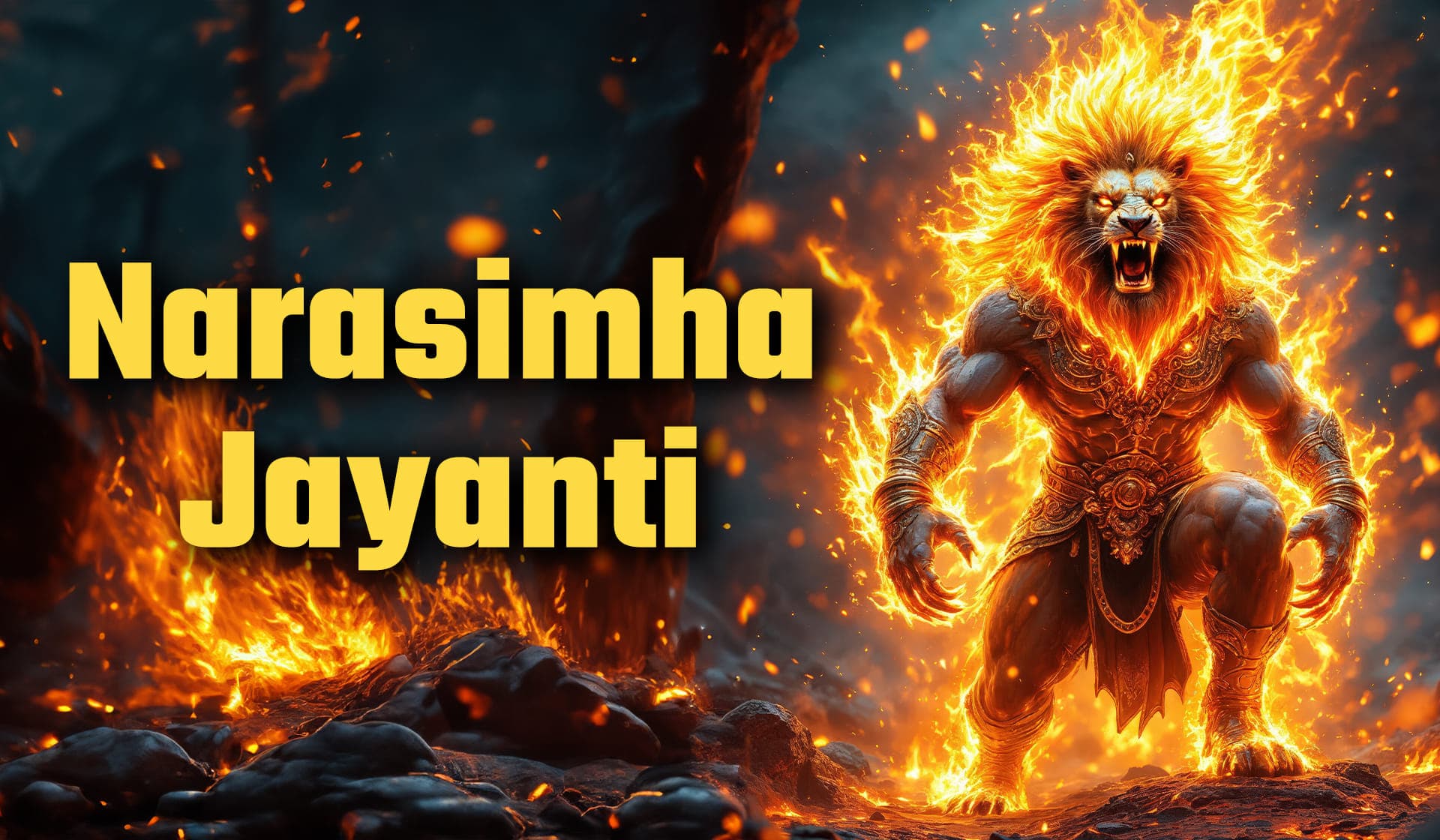
Narasimha Jayanti – Lord Vishnu Avatar Celebration
Narasimha Jayanti 2026: Date, Meaning, Significance, Puja Vidhi
Narsimha Jayanti is not merely a date on the Hindu calendar, it is a profound celebration of the principle that divine protection is always available to those who possess unwavering faith. This sacred day marks the appearance of Lord Narsimha, the fourth incarnation of Lord Vishnu, who manifested as a unique biological hybrid half-man and half-lion to his child devotee Prahalad and restored balance to the universe.
As we approach 2026, understanding the depth of this festival allows devotees to connect more deeply with the energy of “Ugra” (fierceness) and “Kripa” (grace) that Narsimha embodies.
Festival Date, Time, Muhurat & Tithi 2026
The timing of Narsimha Jayanti is governed by the Luni-Solar movements. It falls on the Vaishakh Shukla Chaturdashi - the 14th day of the bright half of the lunar month of Vaishakh.
The specific timing of the Lord’s appearance is critical. Unlike other avatars who appeared at dawn or midnight, Lord Narsimha appeared exactly at Sandhya Kaal. Therefore, the evening window is the most spiritually potent time for worship.
Key Timings for Narasimha Jayanti 2026:
| Event / Detail | Date & Time | Description |
|---|---|---|
| Narasimha Jayanti Date | Thursday, April 30, 2026 | Main festival day |
| Chaturdashi Tithi Starts | Wednesday, April 29, 2026 at 07:51 PM | Beginning of Chaturdashi Tithi |
| Chaturdashi Tithi Ends | Thursday, April 30, 2026 at 09:12 PM | End of Chaturdashi Tithi |
| Sayana Kaal Puja | 04:27 PM to 07:00 PM | Most auspicious time for worship (2 hours 34 minutes duration) |
| Madhyana Sankalp | 11:19 AM to 01:53 PM | Time to take fasting vow |
| Parana (Fast Breaking) | After 06:11 AM on Friday, May 1, 2026 | Time to break the fast after sunrise |
Narasimha Jayanti Significance & Importance
The significance of Narsimha Jayanti stretches far beyond the mythic tale of a king and a lion. It is a festival of Divine Intervention.
The Victory of Dharma Over Adharma
At its core, the day celebrates the victory of Dharma (righteousness). When the demon king Hiranyakashipu gained power, he attempted to rewrite the laws of nature and force the world to acknowledge him as the supreme deity. Narsimha Jayanti reminds us that no matter how organized or powerful “Adharma” becomes, the universe has a self-correcting mechanism.
The Omnipresence of God
The story highlights a central Vedantic truth: God is everywhere. When Prahalada was asked if his God lived in a cold, inanimate stone pillar, his “Yes” was not a guess - it was a realization. Narsimha emerging from the pillar proves that divinity resides in the heart of all matter, waiting to be “activated” by the heat of pure devotion.
Protection From the “Internal” Demons
While the physical story involves a literal demon, modern spiritual teachers emphasize that Hiranyakashipu represents the human Ego. The Ego thinks it is immortal and superior to the Divine. Narasimha represents the "Creative Intelligence" that destroys the ego without harming the soul. Observing this day is said to help practitioners conquer their own anger, pride, and sensory attachments.
Bhagwan Narasimha’s Name & Iconography Significance
The visual representation of Lord Narasimha is one of the most complex and awe-inspiring in Hindu theology. Every element of his form carries a specific metaphysical meaning.
The Hybrid Form: Nara + Simha
The name stems from Nara (Human) and Simha (Lion). This form was a tactical necessity to bypass a boon that protected Hiranyakashipu from "man or beast." Symbolically, it represents the bridge between human intellect and animal instinct, perfected by divine consciousness. It suggests that God transcends all biological classifications.
The Nine Forms (Nava-Narasimha)
In the traditional Agamic scriptures, Narasimha is worshipped in nine distinct moods, each catering to a different human need:
- Ugra Narasimha: The fierce, terrifying form that destroys evil.
- Krodha Narasimha: The angry form, symbolizing the burning of sins.
- Vira Narasimha: The warrior form, granting courage to the timid.
- Vilamba Narasimha: The waiting form, representing patience.
- Kopa Narasimha: The wrathful form.
- Yoga Narasimha: Seated in a meditative posture, representing peace after the battle.
- Jvala Narasimha: The form of pure fire and energy.
- Bhargava Narasimha: The form that blessed the sage Parashurama.
- Lakshmi Narasimha: The most popular form, where the Lord is calmed by Goddess Lakshmi on his lap, representing the balance of power and mercy.
The Claws and The Mane
Unlike other avatars of Vishnu who carry the Sudarshana Chakra to slay enemies, Narasimha primarily uses his claws (Nakha). This signifies that the Lord’s power is innate and does not require external weapons. His flowing mane represents the rays of a thousand suns, illuminating the darkness of ignorance.
The Story of Prahlada and Hiranyakashipu
Hiranyakashipu was driven by a desire for vengeance against Lord Vishnu, who had previously slain his brother, Hiranyaksha. To become invincible, he performed thousands of years of grueling penance. When Lord Brahma appeared to grant him a boon, the King tried to "cheat death" by listing every possible cause of mortality and asking for immunity against them. He asked that he should not die:
- Neither inside a house nor outside.
- Neither by day nor by night.
- Neither on the earth nor in the sky.
- By any man, animal, or god.
- By any living or non-living weapon.
The Devotion of Prahlada
While the King was busy conquering the three worlds, his son Prahlada was born. While still in the womb, Prahlada heard the teachings of the Narada Rishi and became a "Maha-Bhagat" (a supreme devotee). As he grew, he refused to acknowledge his father as God.
The Escalation of Torture
Hiranyakashipu viewed his son’s devotion as treason. He ordered his soldiers to kill the boy. They tried:
- Poison: Prahlada drank it as if it were nectar, and it did not harm him.
- Elephants: Massive elephants were ordered to trample him, but they knelt in respect instead.
- Serpents: Venomous snakes were let loose in his room, but they coiled peacefully around him.
- Fire: The King’s sister, Holika, who had a fire-proof shawl, sat in a pyre with Prahlada. Through divine intervention, the shawl flew off her and covered Prahlada; she burned, and he survived (the origin of Holi).
The Pillar and the Manifestation
In a final fit of rage, Hiranyakashipu pointed to a pillar in the courtyard at sunset. "If your Hari is everywhere, let him save you now!" He struck the pillar. With a roar that shook the foundations of the universe, Lord Narasimha burst forth. The Lord picked up the King, carried him to the threshold (neither in nor out), placed him on his thighs (neither earth nor sky), and at the moment of twilight (neither day nor night), tore into his chest with his claws (neither living nor non-living weapon). The prophecy was fulfilled, and the universe was saved.
How to celebrate Narasimha Jayanti Traditional Observances and Rituals
Celebrating Narsimha Jayanti involves a blend of external worship and internal discipline.
Preparation and Purification Rites
Devotees begin the day with a Brahma Muhurta snan. It is traditional to use Til (sesame seed) or Kusha grass in the bath water to symbolize purification. After cleaning the home, the altar is decorated with fresh flowers, specifically red or yellow ones, which symbolize the Lord’s radiance.
Public Celebrations
In temples, the atmosphere is electric. In South India, especially in the states of Andhra Pradesh and Tamilnadu, many ancient temples like Ahobilam or Simhachalam perform Kalyanotsav - the divine wedding of Lord Narsimha and Maa Lakshmi or Sahastra Kalasha Abhishekam i.e. bathing the deity with 1,000 pots of sacred water.
Dramatic Re-enactments
In many villages, the Bhagavata Mela or Therukoothu (street plays) are performed. Actors wear massive, ornate lion masks and perform the story of Prahlada. It is believed that the actor playing Narasimha often enters a trance-like state, reflecting the raw energy of the deity.
Narasimha Jayanti Puja Vidhi (Puja Procedure)
If you are performing the puja at home, follow this systematic procedure to invite the Lord's presence into your space.
- Deep Prajwalan - light a ghee lamp and two incense sticks. The lamp should ideally stay lit throughout the evening.
- Ganpati and Guru Puja - Before worshipping Narasimha, always offer prayers to Lord Ganesha and your spiritual Guru.
- The Invocation (Avahana) - With folded hands, meditate on the form of Lord Narasimha. Visualize him sitting calmly with Goddess Lakshmi.
- Panchamritam Abhishekam - If you have a metal idol or a Shaligram Shila, bathe it with five substances: milk (representing purity), curd (representing prosperity), honey (representing sweet speech), ghee (representing victory), sugar (representing joy). Follow this with a final wash of pure water mixed with Tulsi leaves.
- Offerings - Offer a yellow cloth. Apply Sandalwood paste and kumkum. Offer Tulsi leaves and lotus flowers. Offer jaggery, water, and black pepper. Perform the aarti with a camphor flame.
Narasimha Jayanti Puja Mantras
Sound vibration is a key aspect of Narasimha worship. These mantras are ancient "seed" sounds used to invoke protection.
Narasimha Ashtakshara Mantra
This is the core 8-syllable mantra:
"Om Namo Bhagavate Narasinhaya"
This mantra is a total surrender. It is used to seek general well-being and to remove fear from the heart.
The Maha-Mantra (Narasimha Anushtubh Mantra)
This is a powerful 32-syllable verse:
"Ugram Viram Maha Vishnum Jvalantam Sarvatomukham|
Nrisimham Bhishanam Bhadram Mrityur Mrityum Namamyaham||"
I bow to the fierce and heroic Maha Vishnu. He is burning with splendor on all sides. He is the terrifying Narasimha, the auspicious one, who is the death of death itself.
Narasimha Kavacham
The Kavacham is a “Shield” of verses. It is believed that by reciting this, each part of the body-from the head to the toes - is placed under the protection of a different aspect of the Lord. It is particularly recommended for those suffering from nightmares, legal troubles, or chronic illness.
Narasimha Jayanti Vrat Vidhi (Fasting Procedure)
Fasting on this day is a form of Tapas that purifies the senses.
- The fast begins at sunrise on the day of Chaturdashi Tithi.
- Devotees can have nirjala fast.
- Only water and liquids like coconut water.
- If health issues then devotees can consume fruits, nuts, and milk products.
- Strictly avoid all grains like rice, wheat, corn, pulses, onions, and garlic.
- Non-vegetarian food and alcohol are strictly forbidden.
- Devotees must observe Brahmacharya (celibacy) during the fasting period.
- It is highly meritorious to stay awake on the night of Narasimha Jayanti (Jagran), chanting his names or listening to spiritual discourses.
Narasimha Jayanti Vrat Katha - The Story of Gajendra Moksha
While the story of Prahlada is the primary legend, the Gajendra Moksha - The Liberation of Gajendra is the traditional Vrat Katha often recited on this day to illustrate the Lord's "Sudden Mercy."
Gajendra was the king of elephants, living in a beautiful garden on Mount Trikuta. He was strong, arrogant, and lived with a large harem of female elephants. One day, while bathing in a lake, a massive crocodile caught his leg.
Gajendra fought the crocodile for a thousand years. His family tried to pull him out, but eventually, they grew tired and left him. As Gajendra was pulled deeper into the water, his physical strength failed, and his ego was crushed.
In his final moment, Gajendra picked up a lotus flower with his trunk, lifted it toward the sky, and called out to the "Primeval Lord." He didn't call Vishnu by name; he called for the "Protector of the Helpless." Lord Vishnu, sensing the urgency and the absolute surrender, appeared instantly, in his fierce form and used the Sudarshana Chakra to slay the crocodile and pull the elephant to safety.
The Spiritual Significance of the Vrat Katha
The story of Gajendra is a profound allegory for the human soul’s journey.
- Gajendra - Represents the human soul (Jiva), which is powerful but weighed down by worldly attachments.
- The Lake - Represents Samsara (the material world), which looks beautiful but contains hidden dangers.
- The Crocodile - Represents Kaal (Time/Death). No matter how strong we are, time eventually catches us.
- The Struggle - Represents our attempt to solve our problems through ego and human effort alone.
- The Lotus - Represents the small seed of devotion that remains in the heart.
The spiritual lesson of the Vrat Katha is that as long as we think "I can save myself," the Lord waits. The moment we say, "I am yours, please save me," the Lord manifests with the speed of thought. Observing the fast and reading this story helps the devotee transition from Ego-reliance to God-reliance.


